In the fascinating intersection where quantum physics meets the living world, a revolutionary scientific discipline is emerging: Quantum Biology. This field challenges our fundamental understanding of life itself by proposing that nature, in its elegant complexity, may harness the bizarre and counterintuitive phenomena of the quantum realm. Far from being confined to the sterile environment of physics laboratories, effects like superposition, entanglement, and tunneling could be active, everyday players in the processes that allow plants to grow, birds to navigate continents, and even in how our very genetic code is maintained. This article delves deep into the compelling evidence and profound implications of quantum biology, exploring how life might be the ultimate quantum technology.
For decades, biology was explained through classical biochemistry a world of molecular locks and keys, diffusion, and chemical reactions. Quantum mechanics, dealing with the behavior of particles at the subatomic level, was considered irrelevant to the warm, wet, and messy world of living cells. Scientists argued that quantum states are too fragile, decohering (collapsing) rapidly in biological environments. However, groundbreaking research over the past two decades has begun to overturn this assumption. It appears evolution, over billions of years, may have perfected ways to protect and exploit quantum weirdness to gain a survival advantage. Quantum biology does not seek to replace classical biology but to enhance it, offering explanations for phenomena that have long remained enigmatic.
A. The Quantum Engine of Photosynthesis: Efficiency Beyond Classical Limits
One of the most robust and startling pieces of evidence for quantum effects in biology comes from the study of photosynthesis the process by which plants, algae, and some bacteria convert sunlight into chemical energy.
The Classical Challenge:
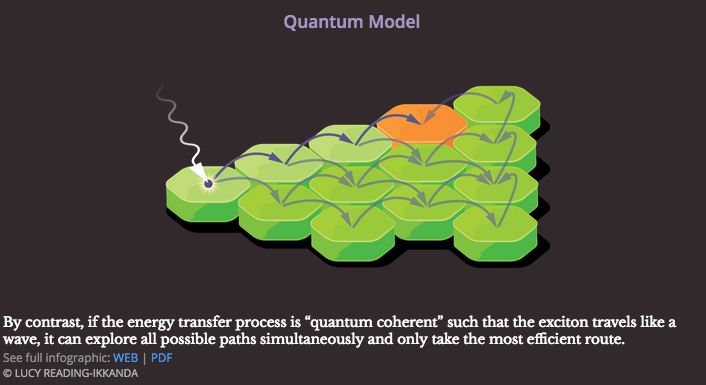
In the initial “light-harvesting” stage, photons of light are captured by a complex of proteins and chlorophyll molecules called an antenna. This energy, termed an “exciton,” must then travel to a reaction center where it can be used. Classically, this journey is modeled as a random walk a haphazard hopping from one molecule to the next. This method is inherently inefficient, with significant energy loss as heat.
The Quantum Revelation:
Advanced spectroscopic experiments, particularly using ultrafast laser spectroscopy, have revealed something extraordinary. The exciton doesn’t just take a random walk. Instead, it appears to exploit a quantum process called coherence. In a state of superposition, the exciton effectively samples multiple pathways through the antenna complex simultaneously. It can “feel out” the most efficient route to the reaction center almost instantaneously, akin to finding the quickest path through a maze by exploring all corridors at once. This quantum coherence, once thought impossible at room temperature in such structures, allows for an energy transfer efficiency exceeding 95%. This quantum-assisted search strategy explains how plants can thrive even in low-light conditions, a mystery classical models struggled to solve.
B. Avian Navigation: The Living Quantum Compass
The annual migration of birds across thousands of miles, with pinpoint accuracy, has long baffled scientists. The leading hypothesis suggests they sense the Earth’s magnetic field. But how? The answer may lie not in a macroscopic magnetic needle, but in a subtle quantum mechanism in their eyes.
The Radical Pair Mechanism:
At the heart of this theory is a quantum process initiated by light. Cryptochrome proteins in a bird’s retina are thought to contain molecules that, when struck by blue light, undergo a chemical reaction that creates a pair of electrons. These electrons are “radical pairs” they are quantum entangled. Their spins (a quantum property) are interlinked, so that the state of one instantly influences the other, regardless of distance.
The Quantum Effect on Navigation:
The spins of these entangled electrons are exquisitely sensitive to the direction and strength of the Earth’s geomagnetic field. The field acts as a filter, influencing the chemical outcome of the radical pair reaction. Different alignments with the magnetic field lead to different proportions of chemical products. It is theorized that the bird’s visual system interprets this quantum-mediated chemical yield as a visual overlay or a perceptual signal essentially “seeing” the magnetic field as patterns of light or darkness. This provides an innate, precise navigational map. The reliance on quantum entanglement, a phenomenon where particles remain connected across space, for a biological function is a staggering concept that blurs the line between fundamental physics and animal behavior.
C. Quantum Tunneling in Enzymatic Reactions and Olfaction
Quantum tunneling is the phenomenon where a particle vanishes on one side of an energy barrier and reappears on the other, without ever having crossed it. This isn’t just theoretical; it’s crucial for life’s chemistry.
Supercharging Enzyme Catalysis:
Enzymes are biological catalysts that speed up chemical reactions vital for life. Classical chemistry suggests molecules must overcome an energy “hill” (activation energy) to react. Enzymes lower this hill, but some reactions were still inexplicably fast. Quantum biology provides the answer: key particles, like protons or electrons, can tunnel through the energy barrier. This is especially prevalent in hydrogen transfer reactions, common in processes like cellular respiration. By utilizing tunneling, enzymes achieve catalytic efficiencies that are millions of times faster than what would be possible classically, making the chemistry of life feasible at body temperature.
Reimagining the Sense of Smell:
The dominant theory of olfaction posits that odorant molecules fit into receptor sites like a key in a lock, based solely on their shape. However, this model fails to explain why molecules with identical shapes but different atomic isotopes (e.g., normal hydrogen vs. heavy deuterium) can smell distinctly different. The vibration theory of olfaction, supported by quantum tunneling, offers a compelling alternative. It suggests that after an odorant molecule binds to a receptor, an electron tunnels across the molecule. The efficiency of this tunneling is modulated by the vibrational frequency of the odorant’s molecular bonds. The receptor essentially acts as a “biological spectroscope,” detecting not just shape, but the quantum-mechanical vibrational signature of a compound. This could explain the incredible sensitivity and discrimination of our sense of smell.
D. Quantum Implications for Genetic Mutation and Stability
The fidelity of our genetic code is paramount. Errors in DNA replication lead to mutations, which drive evolution but also cause diseases like cancer. The mechanism behind one of the most common mutations—the tautomeric shift—has a quantum origin.
The Tautomerization Tunneling Event:
The DNA bases (A, T, C, G) typically exist in a stable, “keto” form that ensures correct pairing (A with T, C with G). Rarely, a base can shift to an alternative, “enol” form via the movement of a proton. In the classical view, this requires a large and unlikely input of energy. Quantum mechanics shows that the proton can instead tunnel to the wrong position, creating a mismatched base pair (e.g., a C pairing with an A). If not repaired, this leads to a permanent mutation during the next round of replication. This demonstrates that quantum events at the subatomic level can have macroscopic, long-term consequences for an organism’s genetics and evolution. Life walks a quantum tightrope, balancing stability with the potential for change.
E. The Frontier: Quantum Biology and Consciousness
The most speculative yet profound application of quantum biology lies in neuroscience. The “orchestrated objective reduction” (Orch-OR) theory, proposed by physicist Sir Roger Penrose and anesthesiologist Stuart Hameroff, suggests that quantum processes within the brain’s microtubules (structural components of neurons) are the seat of consciousness. While highly controversial and lacking definitive experimental proof, it pushes the boundaries of the field. It posits that consciousness arises from quantum gravitational effects on coherent states within neurons, proposing a bridge between quantum physics, biology, and the hard problem of subjective experience. Though not mainstream, it underscores the paradigm-shifting potential of quantum biology to address life’s deepest mysteries.
Addressing the Skepticism: Decoherence and Biological Robustness
The central critique of quantum biology is the issue of decoherence. Quantum states are delicate and easily disrupted by thermal noise and interactions with the environment conditions that define living cells. So, how can life maintain quantum coherence? The answer lies in evolution’s ingenuity. Biological structures appear to be exquisitely designed to protect quantum states for just long enough picoseconds to microseconds for them to be useful. Protein “cages” can shield quantum processes, and biological systems may operate at the “quantum edge,” where coherence is maintained just long enough to perform a specific function before decohering. The wet and warm cell is not a hostile environment for all quantum phenomena; it may be a perfectly tuned one.
The Future and Technological Implications
Understanding nature’s quantum tricks is not just an academic exercise; it holds the key to transformative technologies.
A. Quantum-Inspired Solar Cells: Mimicking the coherence-driven efficiency of photosynthetic antennae could lead to a new generation of ultra-efficient, low-light photovoltaic panels.
B. Biological Quantum Sensors: Deciphering the avian compass could allow us to build hyper-sensitive, room-temperature magnetic sensors for navigation and medical imaging, surpassing current technology.
C. Drug Design and Enzymatic Engineering: Harnessing quantum tunneling could enable the design of new enzymes and pharmaceuticals with unprecedented precision and efficacy.
D. Quantum Computing Interfaces: Biological systems that maintain coherence could inspire new materials or methods for building more stable qubits, bridging biological and synthetic quantum systems.
Conclusion: Redefining the Fabric of Life
The study of quantum biology is a humbling and thrilling frontier. It confirms that nature’s mysteries run deeper than we imagined, woven into the very fabric of reality by the principles of quantum mechanics. From the green leaf in your garden to the migratory bird soaring overhead, quantum effects are not mere curiosities they are functional, essential components of life’s toolkit. As research progresses, we are moving from asking if quantum effects play a role in biology to understanding how, where, and to what extent they do. This convergence of disciplines promises not only to rewrite chapters of biology textbooks but also to illuminate a new path toward sustainable technology, reminding us that the living world is the most sophisticated quantum mechanic of all. The mystery is no longer whether nature is quantum; the mystery is how profoundly quantum nature truly is.