

In an era defined by relentless innovation and a constant re-evaluation of traditional paradigms, the structure of the standard five-day, 40-hour workweek is undergoing its most significant challenge in decades. A growing body of corporate productivity research is delivering a powerful and somewhat surprising verdict: the transition to a compressed, four-day workweek can yield substantial benefits for both organizational performance and employee welfare. This is not merely a utopian ideal for work-life balance; it is a strategic business model backed by empirical data. This comprehensive analysis delves deep into the mechanics, outcomes, and practical implications of this transformative shift, moving beyond headlines to explore how reducing days can actually amplify output, redefine success, and future-proof the modern enterprise.
A. The Empirical Foundation: What Productivity Studies Actually Reveal
Recent landmark studies across diverse global economies from pilot programs in the United Kingdom and Ireland to large-scale trials in Japan and Iceland have moved the conversation from anecdotal evidence to data-driven conclusion. The core finding is consistent: when implemented thoughtfully, a four-day week maintains or even increases overall productivity despite the reduction in total hours spent at work.
This counterintuitive result is rooted in a fundamental restructuring of work processes. The condensed timeframe forces a critical examination of operational inefficiencies that proliferate in a standard week. Key findings from these studies include:
A. Output Maintenance or Increase: Companies across sectors, from professional services to manufacturing, reported that business performance metrics such as project completion rates, client satisfaction scores, and revenue targets were met or exceeded. In many cases, the same output was achieved in 32 hours that previously took 40.
B. Enhanced Employee Focus and Reduced “Time-Wasting”: The precious nature of time becomes acutely felt. Employees and managers alike become proactive in eliminating unproductive meetings, streamlining communication, and reducing low-value administrative tasks. The urgency fosters a culture of “deep work.”
C. A Shift from Hours to Outcomes: The model necessitates a radical shift in managerial philosophy from monitoring hours logged to evaluating tangible results and objectives achieved. This outcomes-based focus aligns employee efforts directly with business goals.
B. The Multifaceted Drivers of Increased Productivity
To understand why fewer hours can lead to more achievement, we must dissect the human and organizational factors at play. The productivity surge is not magic; it is the product of several interrelated psychological and operational improvements.
A. The Psychology of Deadline and Focus: Parkinson’s Law states that work expands to fill the time available for its completion. A condensed week creates a positive, healthy pressure that sharpens concentration. Employees are incentivized to structure their days with greater intention, leading to more efficient use of peak cognitive hours.
B. Drastic Reduction in Employee Burnout and Fatigue: Chronic overwork is a well-documented productivity killer, leading to errors, cynicism, and mental exhaustion. The three-day weekend provides a genuine opportunity for rest, recovery, and personal pursuits. Employees return on Monday (or the first workday) genuinely refreshed, with higher levels of mental energy and creativity.
C. Improved Employee Health and Well-being: With an extra day for appointments, exercise, family time, and hobbies, employees experience significantly lower stress levels. Improved physical and mental health directly translates to fewer sick days, lower presenteeism (being at work but unproductive), and greater engagement while on the job.
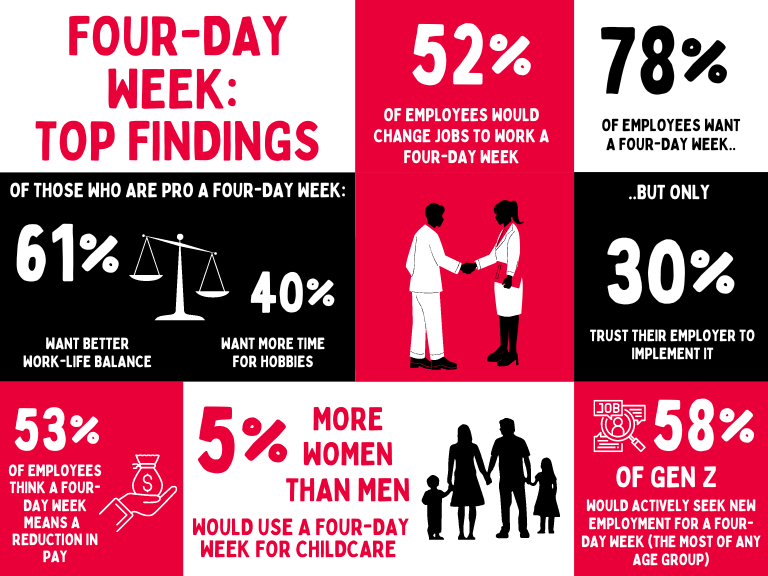
D. Talent Attraction and Retention as a Competitive Advantage: In today’s competitive labor market, offering a four-day week is a powerful differentiator. It drastically reduces costly turnover recruiting and training new staff is far more expensive than retaining top talent. It also attracts high-performing individuals who value autonomy and efficiency.
E. Fostering Innovation and Strategic Thinking: The constant grind of a five-day week often leaves no room for stepping back. The additional breathing room allows employees and leaders to engage in strategic reflection, creative problem-solving, and proactive planning, activities that are crucial for long-term growth but are often sacrificed to daily urgencies.
C. Critical Considerations and Implementation Frameworks
A successful four-day week transition is not a simple blanket policy. It requires meticulous planning, clear communication, and adaptability. Here are the key models and considerations for implementation.
Primary Operational Models:
A. The Condensed Week (4×8): Employees work four longer days (e.g., 8.5-10 hours) to total 34-40 hours. This maintains the same hourly commitment but alters the schedule.
B. The True 32-Hour Week (4×8 at 100-80-100): Employees work four standard 8-hour days at 100% pay, with the expectation of maintaining 100% productivity. This is the model favored by most modern trials and is predicated on the efficiency gains documented above.
C. The Staggered Schedule: Not all staff are off on the same day. Coverage is maintained throughout a five- or six-day operational period by rotating days off. This is essential for customer-facing roles or 24/7 operations.
Essential Implementation Steps:
A. Diagnostic Phase: Analyze current workflows, identify time drains, and survey employees. Which meetings are unnecessary? Where do processes bottleneck? This phase sets the baseline.
B. Redefining Success Metrics: Establish clear, outcome-based Key Performance Indicators (KPIs) for teams and individuals. Shift performance reviews away from activity metrics toward achievement metrics.
C. Technology and Process Optimization: Invest in collaboration tools and automation software. Streamline approval chains, report generation, and internal communications. Eliminate redundant tasks.
D. Pilot Program Launch: Run a controlled, time-bound trial (e.g., 6 months) with a specific department or the entire company. Collect quantitative data (output, revenue) and qualitative feedback (surveys, interviews).
E. Training for Managers: This is perhaps the most critical step. Managers must learn to lead by outcomes, not observation. They need skills in efficient meeting facilitation, priority-setting with their teams, and trust-building.
F. Ongoing Evaluation and Iteration: Use pilot data to refine the model. Be prepared to adjust schedules, processes, or policies based on what the evidence shows. Flexibility is key.
D. Addressing Potential Challenges and Counterarguments
No organizational change is without hurdles. Proactively addressing concerns is vital for stakeholder buy-in.
A. Customer Coverage and Service: For client-serving businesses, a staggered schedule or careful team structuring can ensure all client needs are met without interruption. Clear communication to clients about the new model, often framed as an investment in employee well-being that yields better service, is crucial.
B. Industry Suitability: While easily adapted for knowledge and creative work, industries like healthcare, manufacturing, or retail require more creative solutions, such as shift overlaps or a 32-hour week without a fixed three-day weekend. The core principle is rethinking scheduling for well-being and efficiency, not a one-size-fits-all approach.
C. Risk of Increased Work Intensity and Stress: Without proper management, the condensed time could lead to rushed work or unsustainable daily intensity. This is why the focus must be on eliminating low-value tasks, not just cramming five days of work into four. Managerial training and employee feedback loops are essential safeguards.
D. Financial Implications for Hourly Workers: For non-exempt (hourly) employees, moving to a 32-hour week at the same pay represents a pay increase on an hourly basis. Companies must evaluate this cost against savings from reduced turnover, lower healthcare costs, and heightened productivity. Many trials find the financial benefits balance or outweigh the costs.
E. The Broader Impact: Beyond the Balance Sheet
The implications of a widespread shift extend far beyond individual company metrics, potentially catalyzing broader societal and economic change.
A. Environmental and Sustainability Benefits: A 20% reduction in commuting for a large workforce translates to a significant drop in carbon emissions and traffic congestion. Reduced office energy consumption on the extra off day further contributes to a company’s sustainability goals.
B. Promotion of Gender Equity: The current five-day model often disproportionately burdens caregivers, frequently women, with rigid schedules. A four-day week, especially with flexible scheduling, provides more manageable time for domestic responsibilities, potentially fostering a more equitable distribution of labor at home and retention of female talent in the workforce.
C. Community and Social Well-being: Employees gain time to engage in community activities, volunteer, support local businesses on weekdays, and strengthen family and social bonds. This contributes to the social fabric and overall societal health.
D. Redefining the Social Contract of Work: It challenges the deeply ingrained notion that time spent at a desk is synonymous with contribution and loyalty. It moves us toward a model that values human capital holistically, recognizing that a rested, fulfilled, and autonomous individual is the most valuable asset any organization possesses.
Conclusion: The Future of Work is Efficient, Not Just Extended
The corporate productivity study evidence is compelling and can no longer be dismissed. The four-day workweek, particularly the 32-hour model at 100% pay, emerges not as a radical employee perk, but as a sophisticated operational strategy for the 21st century. It is a powerful lever to address the twin crises of modern business: widespread burnout and stagnant productivity growth.
For forward-thinking leaders, the question is shifting from “Can we afford to do this?” to “Can we afford not to?” In a world competing for talent, innovation, and resilience, optimizing for sustainable human performance is the ultimate competitive edge. The data-backed revolution of the four-day week signifies a maturation in management thinking one that understands that the greatest returns on investment come not from extracting more time, but from cultivating a more energized, focused, and profoundly engaged workforce. The future of work is not about working longer; it’s about working smarter, healthier, and with a purposeful design that honors both corporate objectives and human flourishing.